Author: Erik Brown

  • Almost Like God Knows What He’s Doing

    Almost Like God Knows What He’s Doing

    One of the pastors’ homes under construction when we arrived.

    In the fall of 2022, I traveled to eastern Uganda with work pants, gloves, and every expectation that I would help build homes for pastors. Five of us from Riverwood Covenant Church spent ten days in Uganda, based in Soroti. I never put on the gloves. Not once.

    The homes had been funded before we arrived so construction could begin without waiting for us. By the time we got there, experienced local workers were already making progress. They were young, fit, accustomed to the heat, and knew what they were doing. Had we joined them, our primary contribution probably would have been slowing them down. That isn’t false humility. I’m pretty sure it’s an accurate assessment.

    It turned out to be a blessing. Instead of spending our time getting in the way at construction sites, we visited nine pastors’ homes and blessed them. We sat with people, ate the food they prepared for us, and spent time together in their villages. We also participated in children’s ministries at two schools, attended a church service in Soroti, and held a marriage conference for pastors and their wives.

    About 800 remarkably attentive students listened as we spoke about Jesus.

    I was completely unprepared for how important something as simple as sitting down and sharing a meal would be. Again and again, people said, “Thank you for loving us.” It absolutely leveled me. We had traveled thousands of miles expecting to demonstrate love through what we did. What many people valued most was that we came to their homes, ate their food, listened, worshiped, laughed, and spent time with them. It melted my heart then, and the memory still does.

    Our mission team, a local pastor, and the homeowner praying, giving thanks, and dedicating the new home to God.

    One of the greatest personal blessings was meeting Gloria. Kerrie and I had sponsored her for several years, but I never expected to meet her in person. Pastor Joseph assured me before the trip that he would make it happen, and he did. Sponsoring someone from thousands of miles away is meaningful, but it can also feel a little abstract. Gloria was no longer a name, a photograph, or someone we heard about through occasional updates. She was a young woman sitting in front of me. Meeting and talking with her was the highlight of the trip.

    Meeting Gloria was the highlight of the trip.

    I also came home with a different understanding of wealth. Many of the people we met had very little materially. Some had no electricity or running water. Some lived in homes with dirt floors and roofs that might last only a few years. In the most difficult circumstances, getting water required a long walk, and the water available was not necessarily clean.

    I don’t want to minimize those hardships. A lack of clean water, durable housing, or reliable income is real. At the same time, describing the people we met only by what they lacked would miss much of the truth. They may have been economically disadvantaged to a depth I had never personally witnessed, but I have a hard time calling them poor. They were rich in joy, faith, warmth, and generosity.

    Many were getting by day by day, yet they displayed more joy than people I know who earn literally twenty times as much. They welcomed us into their homes, fed us, prayed with us, and repeatedly thanked us for loving them. I went there expecting the trip to enrich me spiritually. It did, although far more than I anticipated and not in the way I expected.

    That memory still corrects me. When I catch myself feeling disgruntled over some minor annoyance, I think about the people I met in Uganda. I remember their joy, generosity, faith, and gratitude. Whatever is irritating me does not always disappear, but it usually returns to its proper size.

    We did not build the homes. They were already being built by people far better equipped to do it. Our role was to encourage, listen, share meals, form relationships, worship together, and love people. Perhaps that was the work we were meant to do all along.

    You make the best plans you can and then God steps in, changes them, and makes something far better happen. Almost like God knows what He’s doing.
  • Look for What’s Missing

    One of the most useful things I’ve learned from working with data is to look for what’s missing.

    I don’t mean missing data in the traditional sense. I mean stepping back from what’s in front of me and asking whether we’re even looking at the right things.

    When I’m building or reviewing a report or dashboard, some of the most important questions I ask are:

    • How is this supposed to be actionable?
    • What decision am I trying to influence, inform, or support?
    • Who is the intended audience or information consumer?
    • What would someone do differently if this number changed?

    And then: What’s missing?

    That last question has saved me a lot of time over the years. More importantly, it has occasionally helped me realize we were solving the wrong problem.

    Eight Million Records to Get 8,000

    Years ago, I was contracted to rewrite a collection of Crystal Reports into Microsoft Reporting Services. The decision had already been made before I arrived. The client believed the existing queries were inefficient and wanted them rewritten as stored procedures. The assumption was that stored procedures and the newer reporting platform would perform better.

    They were both right and wrong.

    There was definitely a performance problem. Some queries took three or four hours to run, consumed an enormous amount of server resources, and occasionally failed before the report could even display. But the important problem wasn’t Crystal Reports versus Reporting Services. It wasn’t even SQL queries versus stored procedures. It was where the filtering occurred.

    The queries were returning roughly 8 million records. The report then filtered those records down to what the user actually needed: about 8,000 records. We were moving and processing millions of records just so the reporting software could throw almost all of them away.

    Once I moved the filtering into the query, processing time dropped from hours to about ten minutes. The reports stopped draining the server and displayed reliably.

    The technology mattered. But it wasn’t the important question. The important question was the one nobody was asking.

    Three Hours Became Fifteen Minutes

    Another client had a report requiring someone to spend about three hours reviewing it every morning. The purpose was to identify displays that needed attention so representatives could be sent out to fix them.

    My question was pretty simple: What makes something an exception? What is too high? What is too low? What actually requires someone to do something?

    Once the client could define those conditions, there was no reason for a person to spend three hours looking through everything that was normal. I created an exception report, and the morning process went from about three hours to about fifteen minutes.

    Today, exception reporting isn’t particularly novel. At the time, around 2010, very few people I encountered were doing it. The important part wasn’t the technology anyway. It was changing the question.

    Instead of asking, “How can we make it easier to review all this data?” we asked, “Why are we making someone look at data that requires no action?”

    That question still influences how I think about dashboards today. If a number changes, what would you do differently? If the answer is nothing, I start wondering why we’re asking someone to look at it.

    The Report Nobody Missed

    Sometimes what’s missing isn’t a number at all.

    At one company, users were supposed to pull a report every workday, look through six tabs, and find anomalies. I argued with my boss that nobody was doing it; they were too busy to pull a report every morning and do that much searching for something that was usually within normal parameters. He insisted they were doing it.

    Then the report stopped working. For two weeks. Nobody contacted me.

    That seemed like a pretty good piece of missing information.

    I redesigned the report. Instead of requiring users to go find it, a one-page PDF containing the important information was emailed directly to the distribution list. Push instead of pull. One page instead of six tabs.

    About a month later, the report failed again. I had six messages asking about it before I even got to my desk.

    The original report wasn’t necessarily missing information. It was missing its audience. We sometimes spend enormous amounts of effort deciding what information belongs in a report and surprisingly little time thinking about the person who is supposed to use it.

    A report nobody reads can be perfectly accurate and completely useless.

    Sometimes the Missing Information Is on the Other Side

    Eventually I realized that looking for what’s missing isn’t only useful when I’m creating reports. It’s also useful when someone else is presenting information to me.

    Around 2005, a United Way representative came to the company where I worked as part of an annual charity drive. During the presentation, she said United Way had helped 2 million people the previous year.

    At the time, Minnesota had a population of roughly 5 million.

    Something didn’t add up. If she meant United Way had helped 2 million people in Minnesota, that would have been around 40 percent of the entire state population.

    I didn’t know what was wrong with the number. Maybe nothing was. Perhaps 2 million referred to people nationally rather than in Minnesota. Maybe it represented services provided rather than unique individuals. Maybe one person receiving help from two programs was counted twice. Maybe “helped” had a definition I didn’t understand.

    The problem wasn’t necessarily the number. The problem was the missing context.

    And I think that distinction matters. Looking for what’s missing doesn’t mean assuming people are lying to you. It doesn’t mean distrusting every statistic or looking for some sinister motive behind every chart.

    It means asking whether you have enough information to reach the conclusion you’re being invited to reach.

    That’s skepticism. It doesn’t have to become cynicism.

    The Question Behind the Question

    I don’t remember when I started saying “look for what’s missing.” It wasn’t a technique someone taught me. It’s simply a name I eventually gave to something I learned through a lot of experiences, both good and bad.

    Sometimes what’s missing is another piece of data. Sometimes it’s context. Sometimes it’s the intended audience or the action someone is supposed to take. Sometimes we’re measuring the wrong thing.

    And sometimes the biggest thing missing is the question nobody thought to ask.

    We have access to more data than ever before. That doesn’t necessarily mean we understand more.

    The next time a report, dashboard, presentation, news story, salesperson, chart, or even your own analysis seems to point toward an obvious conclusion, don’t automatically assume it’s wrong.

    Just remember to ask:

    What’s missing?

  • The Big Interest Rate Lie

    The interest rate on our promissory note is 2.625%. A phenomenally low interest rate. Maybe even historically low.

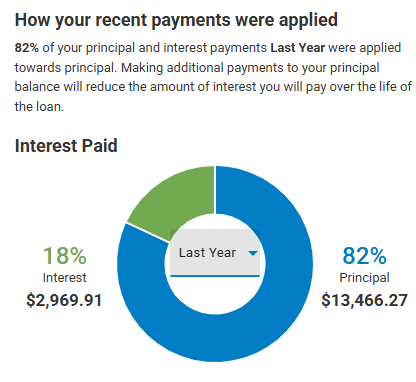
    However, it’s hogwash. Look at that rate. Look at the graph. And look again. 18% of our mortgage payments went to interest. The chart below shows a breakdown of principal and interest from Kerrie’s and my mortgage payments last year.

    Now, before you tell me I’m doing the math wrong, let me explain. Nothing about my mortgage statement is technically inaccurate. The 2.625% is real, and the calculation is perfectly legitimate. The problem is what that number makes us think.

    Mortgage interest is calculated each month based on the remaining balance. In my case:

    (.02625 ÷ 12) × remaining balance = monthly interest

    Let’s say we owe exactly $100,000. At 2.625%, that works out to $218.75 in interest. If our monthly payment is $1,278, then $218.75 ÷ $1,278 = 17.1%.

    So we have a 2.625% interest rate, but 17.1% of that month’s payment is going toward interest. As the balance decreases, the interest portion decreases too, which is why our actual percentage varies. Over the course of last year, 18% of our total mortgage payments went toward interest.

    That’s a pretty big difference between the number we focus on and where our money is actually going. This is where I think we have an interesting problem with the way we talk about mortgages.

    “Don’t pay that thing off early! That’s practically free money!”

    That’s what you’re likely to hear from your banker, financially savvy friend, or Joe Schmoe off the street when they hear you have a 2.625% mortgage.

    I’m not so sure.

    I’m not arguing that a 2.625% mortgage is a bad loan. It isn’t. It’s a very good loan. And I’m certainly not arguing that everyone should rush out and pay off their mortgage. There are legitimate reasons to keep a low-interest mortgage and invest the money instead. What I am arguing is that the interest rate by itself doesn’t tell the whole story.

    Last year, Kerrie and I paid $2,969.91 in interest. That’s real money. It didn’t reduce our mortgage balance or build equity. It was the cost of borrowing the money. So maybe we should spend less time asking, “What’s my mortgage rate?” and more time asking, “How many actual dollars am I sending to the lender that aren’t reducing what I owe?”

    For us, last year, the answer was nearly $3,000.

    The better question isn’t whether 2.625% is a good interest rate. It is. The better question is: What is the best use of the next dollar? Should it go toward the mortgage? Into investments? Stay in cash?

    There isn’t one answer for everyone. Taxes, investment returns, risk, liquidity, and personal circumstances all matter. But I don’t think “You have a 2.625% mortgage, so you should never pay it off early” is good enough.

    Every dollar of principal you pay off eliminates the future interest that would have been charged on that dollar. That’s a guaranteed savings. An investment might earn more than 2.625%. It might not. Paying down the mortgage gives you a certain return equal to the interest you no longer have to pay, and you owe less money.

    So yes, we have a 2.625% mortgage. It’s a fantastic interest rate. But don’t confuse a fantastic interest rate with a mortgage that costs you very little.

    And maybe the bigger lie isn’t the interest rate itself. Maybe it’s the idea that the interest rate tells us everything we need to know about what our mortgage is costing us.

  • The REAL student interest loan rate

    In my opinion, the banks, your school, the government all legally lie to you about the interest rate you pay on your student loans. This is based on observation and experience that I share further on in this post if you care to learn.

    My son took out two student loans to help pay for college. No one forced him to take out the loans and this is not a post looking for loan forgiveness. This post is to educate anyone willing to listen, review the facts, and check out their own loans (or those of their children).

    If math is not your strong suit, either in ability or personal interest, you may want to skip to the end. The original loan balance: $17,944.00; the current balance when creating this post was: $13, 442.99. The note said 4.35% interest. Hogwash!

    Let’s look at some inconvenient facts. Very inconvenient for my son or anyone else paying back just following the payment book. To date, the total principal paid: $8520.81; the total interest paid: $4137.61 (48.55%). He did have a couple deferrments in there, but should not be enough to equal almost 50% interest.

    I put the numbers in the narrative paragraph above into a table below, rounding everything to the nearest dollar and the nearest tenth of a percent. So, there will be some rounding errors in the table, but the errors are insignifcant and the table is easier to follow.

    DescriptionPrincipalInterestInterest as percent of principal
    Totals$8,521$4,13848.6%
    Monthly Payment$192$4920.2%

    You don’t believe me, you say. He must have had more deferments than you remember or are willing to admit. Let’s look at the payments and see the story they tell. His minimum payment is $241.14. When he makes that payment, the interest amount is $48.75, leaving $192.39 for principal. If you take $48.75/$241.14 you get 20.2%. Read that over again and really let it sink in. His other loan was even worse at about 25%.

    How can this be legal you ask? Simple, the 4.35% interest advertised and promoted to borrowers and co-signers is interest calculated, and compounded, each month based on the total balance.

    From the banks point of view, the interest rate is 4.35%. Take $13,443 (current balance) *(.0435 (annual rate) /12 (one month)) = $48.75.

    From a practical standpoint, 48.75/241.14 translates to 20.2%. This will be your actual interest rate if you don’t pay extra. If you or someone you support financially or love has a student loan I implore to look at the statement and calculate it for yourself. If you don’t feel financially accosted I cannot relate to you.