The interest rate on our promissory note is 2.625%. A phenomenally low interest rate. Maybe even historically low.
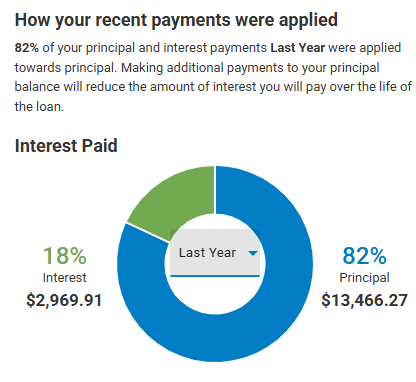
However, it’s hogwash. Look at that rate. Look at the graph. And look again. 18% of our mortgage payments went to interest. The chart below shows a breakdown of principal and interest from Kerrie’s and my mortgage payments last year.
Now, before you tell me I’m doing the math wrong, let me explain. Nothing about my mortgage statement is technically inaccurate. The 2.625% is real, and the calculation is perfectly legitimate. The problem is what that number makes us think.
Mortgage interest is calculated each month based on the remaining balance. In my case:
(.02625 ÷ 12) × remaining balance = monthly interest
Let’s say we owe exactly $100,000. At 2.625%, that works out to $218.75 in interest. If our monthly payment is $1,278, then $218.75 ÷ $1,278 = 17.1%.
So we have a 2.625% interest rate, but 17.1% of that month’s payment is going toward interest. As the balance decreases, the interest portion decreases too, which is why our actual percentage varies. Over the course of last year, 18% of our total mortgage payments went toward interest.
That’s a pretty big difference between the number we focus on and where our money is actually going. This is where I think we have an interesting problem with the way we talk about mortgages.
“Don’t pay that thing off early! That’s practically free money!”
That’s what you’re likely to hear from your banker, financially savvy friend, or Joe Schmoe off the street when they hear you have a 2.625% mortgage.
I’m not so sure.
I’m not arguing that a 2.625% mortgage is a bad loan. It isn’t. It’s a very good loan. And I’m certainly not arguing that everyone should rush out and pay off their mortgage. There are legitimate reasons to keep a low-interest mortgage and invest the money instead. What I am arguing is that the interest rate by itself doesn’t tell the whole story.
Last year, Kerrie and I paid $2,969.91 in interest. That’s real money. It didn’t reduce our mortgage balance or build equity. It was the cost of borrowing the money. So maybe we should spend less time asking, “What’s my mortgage rate?” and more time asking, “How many actual dollars am I sending to the lender that aren’t reducing what I owe?”
For us, last year, the answer was nearly $3,000.
The better question isn’t whether 2.625% is a good interest rate. It is. The better question is: What is the best use of the next dollar? Should it go toward the mortgage? Into investments? Stay in cash?
There isn’t one answer for everyone. Taxes, investment returns, risk, liquidity, and personal circumstances all matter. But I don’t think “You have a 2.625% mortgage, so you should never pay it off early” is good enough.
Every dollar of principal you pay off eliminates the future interest that would have been charged on that dollar. That’s a guaranteed savings. An investment might earn more than 2.625%. It might not. Paying down the mortgage gives you a certain return equal to the interest you no longer have to pay, and you owe less money.
So yes, we have a 2.625% mortgage. It’s a fantastic interest rate. But don’t confuse a fantastic interest rate with a mortgage that costs you very little.
And maybe the bigger lie isn’t the interest rate itself. Maybe it’s the idea that the interest rate tells us everything we need to know about what our mortgage is costing us.

